


The real reason your trading profits have stalled (it’s not your strategy)
* Trading is risky. Your capital is at risk.
When it comes to trading, better isn't always about doing more.
Traders who make a serious amount of money in forex aren't necessarily the ones running the most complex strategies. They're not always the ones with the most screens, the most indicators, or the longest watchlists.
What they do have is an environment that doesn't fight them. One where the cost of each trade is known, the execution is clean, and nothing in the infrastructure is quietly eating into their bottom line.
Most traders never think about this. They spend years refining strategy and almost no time examining the structure those strategies are operating inside. That's a mistake - and at scale, it's an expensive one.
Accounts like FXTM's Advantage Premier aren't a reward for reaching a certain level. It's the infrastructure that level requires.
Key takeaways
At high volume, account structure is a primary performance variable, not a secondary one
Upgrading to an efficient commission-based account like Advantage Premier can save you $1,000s in fees
Traders who plateau aren't failing at strategy - they're operating in the wrong environment for their level
How serious traders actually develop
Not every trader goes through the same arc. But the pattern is consistent enough to be worth mapping.
Early on, the focus is survival. You're learning market structure, managing risk, trying to understand why your positions behave the way they do. At this stage, account type is irrelevant. A standard account is exactly right. It's simple, accessible, and the all-in costs — while not tight — are not the limiting factor. Your skill is.
Then something changes.
You start seeing consistency. Losses aren't random anymore - they're a manageable, expected, part of the model. You're aware of spreads and commissions in a way you weren't before. You know roughly what each trade costs you. You're probably still underestimating the cumulative impact, but the awareness is there.
By the time you're in what most would call the serious or scaling stage (trading meaningful size, running a tested system, thinking about net performance rather than individual trades) the calculus has shifted entirely.
You're no longer asking: how do I find better trades?
You're asking: why aren't my results reflecting what my system should be producing?
That's the question that eventually leads every experienced trader to examine their infrastructure.
Developing traders ask: "How do I improve my strategy?"
Serious traders ask: "Why isn't my edge fully translating into results?"
One question leads to more chart time. The other leads to a structural audit.
"What feels like a strategy problem is almost always an environment problem. The distinction matters because the fix is completely different."
The plateau most traders misdiagnose
Sady, it doesn't announce itself.
There's no single loss that tells you something's wrong. No obvious mistake to dissect and fix. Just a quiet, accumulating sense that the numbers should be better than they are.
Your win rate is consistent, your risk management is disciplined, you've been profitable over a sustained period. But growth has stalled. Small frustrations with execution are building. You're spending more time reviewing trades that felt right but produced less than they should have.
The instinct is to go back to the strategy. Adjust the entry criteria, tighten the stop rules or test a different session. Most traders do this but it rarely moves the dial, because the strategy isn't the problem.
What feels like a strategy problem is almost always an environment problem. The distinction matters because the fix is completely different. Optimising a working strategy to extract marginal gains is difficult and often counterproductive. Identifying and removing structural friction - unnecessary cost, inconsistent execution, misaligned pricing - is comparatively straightforward, if you know what to look for.
Four places profitable traders break down
Cost drag: the compounding effect nobody tracks closely enough
Commission-free standard accounts make money for the broker by building their margin into the spread. The trader sees a simple, clean price. What they don't see is that the gap between what the market offers and what they're quoted is the broker's return — built into every single trade.
An ECN trading account like the FXTM Advantage Premier account works differently. Instead of marking up the spread, the broker charges a transparent, fixed commission per lot and passes the raw interbank price directly to the trader. No markup. No hidden margin in the quote. The cost is visible, fixed, and modelable in advance.
The practical difference using FXTM's own account pricing: a commission-free standard account (such as Advantage Plus) carries spreads from 1.5 pips all-in on EUR/USD. The Advantage Premier account offers raw spreads from 0.0 pips plus a commission of $3.50 per lot per side - bringing the total all-in cost to approximately 0.7 pips equivalent on a standard lot.
That's a gap of 0.8 pips per trade.
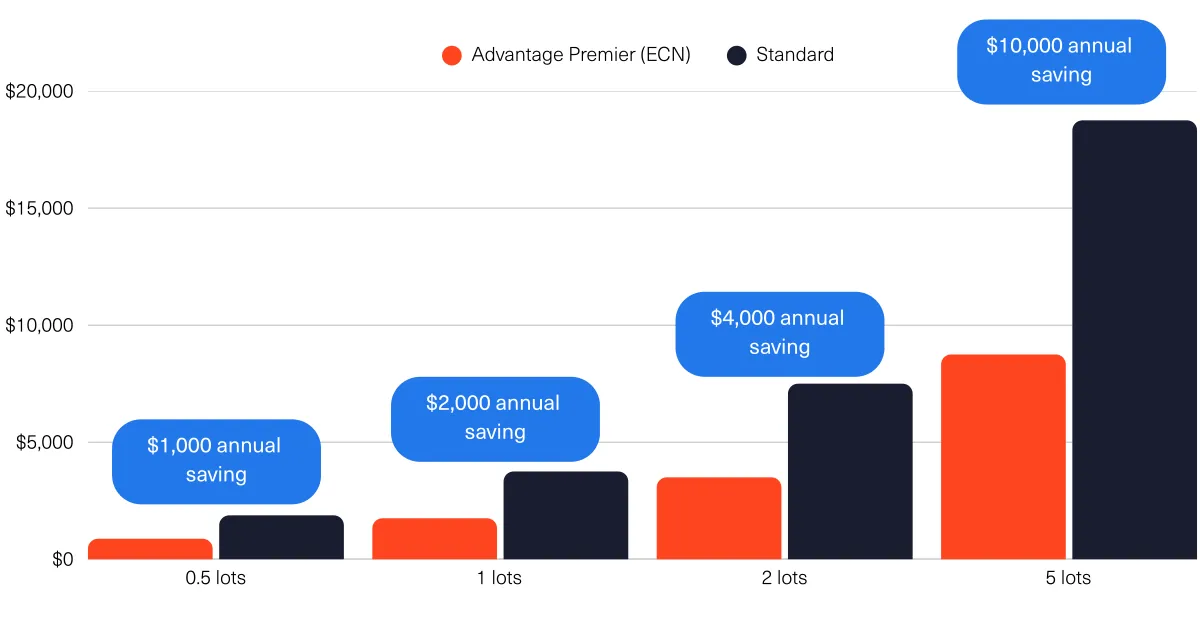
Run it at volume. Using a modelling baseline of 250 trades per year (roughly 1 trade per day, 5 days a week, across 50 active trading weeks) and at 0.8 pips per trade on a standard lot (EUR/USD, $10 per pip), that's $8 of unnecessary friction per trade, or $2,000 in annual cost drag that simply doesn't exist on the right account structure.
At two lots per trade, that figure doubles to $4,000. At five, it becomes $10,000.
Annual Cost Drag: Advantage Premier (ECN) vs Standard Account
Execution quality: what you're quoted versus what you get
Commission-free standard accounts typically operate on a market-maker or dealing-desk model, where the broker takes the other side of your trade and manages their exposure separately. This creates an inherent tension between the broker's optimal outcome and yours.
An ECN account removes this. Your order goes directly into the liquidity network and is matched with a real market participant — a bank, an institution, another liquidity provider. The broker charges a commission and steps out of the transaction. No dealing desk. No manual intervention.
No conflict of interest in the fill.
The practical effect shows up most clearly in volatile conditions during data releases, during the open of major sessions, during the moments when execution matters most. ECN direct market access connects to real depth of market. Dealing-desk standard accounts, where the broker is actively managing their book, can widen spreads or fail to fill at the price shown.
At high volume, those moments of inconsistent execution accumulate into a material drag that no amount of strategy refinement will resolve.
Pricing that doesn't match your profile
Commission-free standard accounts are priced for the median retail trader.
A single spread model that works across all client types, all volumes, all strategies. Simple to administer. Not designed to optimise for anyone in particular.
A trader deploying meaningful capital across multiple sessions per week is not the median retail trader. An ECN account with a fixed commission structure changes this relationship — your cost per trade is the same whether you're trading in calm or volatile conditions, and it scales predictably as your volume grows.
A structure built for access, not for performance
Standard accounts exist to lower the barrier to entry. That's their purpose and they fulfil it well. But a structure designed for accessibility and a structure designed for efficiency at scale are not the same thing.
At a certain point in a trader's development, operating on infrastructure that wasn't built for their stage stops being a minor inefficiency and starts being a meaningful constraint.
How professional traders think about this
There's a clear line between retail thinking and professional thinking. It's not a function of capital. It's a function of where you direct attention.
Retail traders are strategy-focused. They're looking for the better signal, the tighter entry, the refined setup. Costs exist in the background but aren't ever really scutinised.
Professional traders are system-focused. They take their edge as a starting point and ask: what's reducing it? Costs aren't fixed. Execution quality isn't fixed. The pricing model isn't fixed. Each is a variable, and variables can be improved.
Professionals don't just trade better. They operate in better conditions.
Retail Thinking | Professional Thinking | ||
|---|---|---|---|
Primary focus | Find a better strategy | Optimise the system | |
View of costs | Background overhead | Material performance variable | |
Execution | Accepted without question | Scrutinised and benchmarked | |
Account structure | Default standard | Matched to trading profile | |
Key question | "Am I winning enough?" | "Is my edge fully translating?" |
The shift in thinking happens before the shift in account. But one follows the other.
What traders actually evaluate before switching
When serious traders assess whether their account structure is right for their stage, the conversation stops being about features and starts being about performance metrics.
The questions worth asking:
- What is my actual all-in cost per round turn? Not the headline spread figure — the total cost including any commission. Most traders who haven't calculated this recently are surprised by the answer.
- Is my pricing transparent? A raw spread plus a fixed commission is auditable. You can model it precisely. A blended spread markup is not.
- If you can't model your trading costs in advance, your performance analysis has a gap in it.
- Does my execution hold up when it matters? Not in calm conditions. During the sessions and events where your strategy generates its edge.
Consistent fills at volatile moments come from direct market access, not something a dealing-desk account structure is designed to guarantee.
Does this structure scale with my volume? As position sizes grow, the difference between raw ECN pricing and a marked-up standard spread becomes more significant, not less. An account that was efficient at lower volume can become structurally expensive as size increases.
Two traders: Identical strategy. Different structure.
James and Michael trade the same system.
EUR/USD. Momentum-based setup on the 1-hour chart. Average target: 18 pips. Average stop: 9 pips. 55% win rate. 8 trades per week. 2 standard lots per trade.
On paper, identical.
James is on a commission-free standard account. All-in cost: 1.5 pips per round turn (based on FXTM Advantage Plus pricing).
Michael is on an ECN account. All-in cost: 0.7 pips per round turn (based on FXTM Advantage Premier: 0.0 pips raw spread + $3.50/lot/side commission).
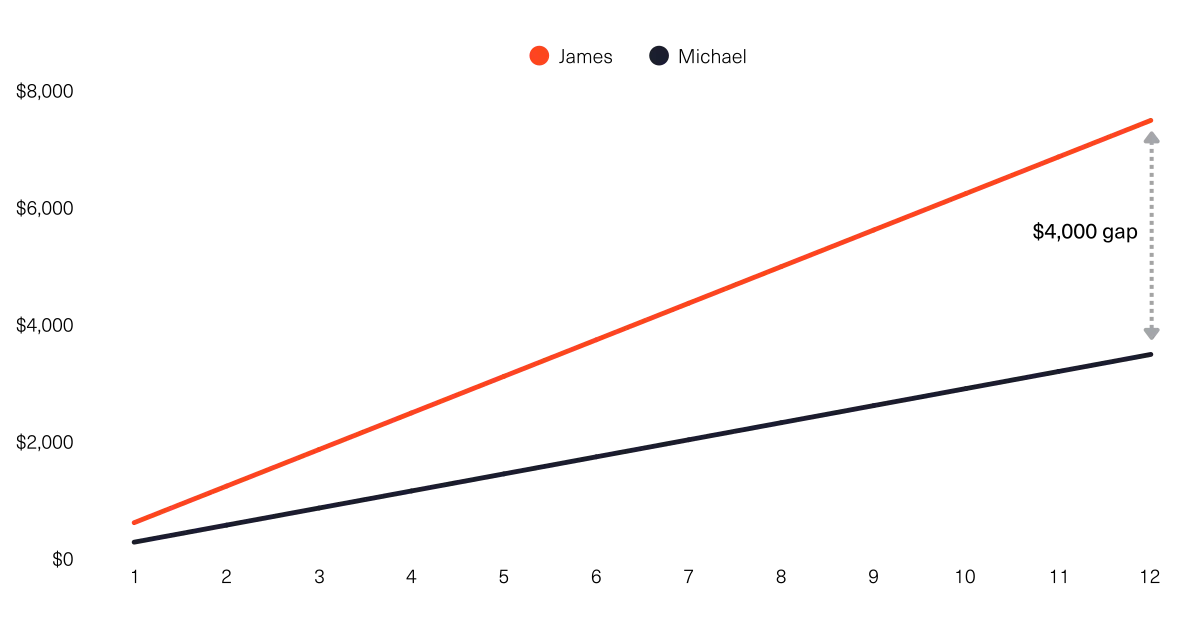
Over 12 months, 250 trades each:
James pays approximately $7,500 in total trading costs.
Michael pays approximately $3,500.
That's a $4,000 difference in net outcome before a single market decision is made. Not because Michael is a better trader. Not because his strategy is sharper. Because his account is matched to his level.
At 5 lots per trade — assuming an account size and risk profile where that position size is appropriate — that gap becomes $10,000 annually.
The edge wasn't in the strategy. It was in the structure.
Cumulative trading cost: Standard vs ECN (FXTM Advantage Premier) account
Where the Advantage Premier account fits in
FXTM's Advantage Premier account is an ECN account with improved transparent, fixed commission structure, meaning your cost per trade is determined by the raw spread and a flat fee per lot, not by a marked-up spread that varies with market conditions or broker discretion.
It is not designed for every trader, and that's worth stating plainly.
If you're still developing your system, refining your approach, or trading at lower volume while building consistency, a commission-free standard account (like Advantage Plus) is the right tool for that stage.
Advantager Premier becomes relevant when cost structure and execution quality have moved from theoretical concerns to material performance variables. When you're trading meaningful size, running a tested system, and your numbers suggest your edge should be producing more than it is.
How does Advantage Premier differ from Advantage?
Advantage Premier is for frequent, experienced traders who trade at high volumes.
It also offers some exclusive perks over the regular Advantage account, including improved pricing on gold and precious metal trading.
Advantage Premier clients can enjoy commissions of $10 per million notional traded (vs $25 per million notional on the Advantage account).
Trade XAU/USD? Save up to $1,875 annually in fees by switching to Advantage Premier from Advantage.
XAU/USD trading costs: Advantage v Advantage Premier
| Trade Size | Savings per Trade | Total Saving |
|---|---|---|
2 lots | $3 | $750 |
5 lots | $7.50 | $1,875 |
*Based on 250 trades annually.
The signals that you're at the transition point
The move to an ECN account like Advantage Premier isn't about crossing an arbitrary threshold.
It's about recognising when your current structure has become the constraint. Here are four questions worth sitting with:
- Are you trading higher volume consistently — not as an occasional peak, but as your normal operating baseline?
- Have you calculated your precise all-in cost per round turn and tracked it across the last 6–12 months?
- Are small inefficiencies in execution or pricing noticeably impacting results — particularly around news events or the open of major sessions?
- Do your results consistently underperform what your win rate and risk-reward ratio suggest they should be producing?
If the answer to most of those is yes, you're not looking at a strategy problem. You're at the transition point.
The bottom line
Growth in trading isn't linear.
In the early stages, almost everything comes from skill. Reading markets, managing risk, finding and holding an edge. The account structure barely registers because the skill gap is the limiting factor.
At the level serious traders operate, that changes. The skill gap narrows.
The structural differences don't. And the traders who keep progressing aren't the ones endlessly refining an already-working strategy — they're the ones who've identified what's constraining it and removed it.
Account structure is a performance variable. It always was. At meaningful volume, it becomes one of the most actionable ones left.
Find out what your current account structure is actually costing you and whether the FXTM Advantage Premier account is matched to your trading stage.