


Why you need to diversify gold in 2026
* Trading is risky. Your capital is at risk.
XAU/USD. Does a trader need any other instrument?
It's a common belief. And in 2025, it would have been a profitable one, too.
For many traders, XAU/USD is the bread and butter of their strategy. It’s volatile, liquid, and historically, a safe haven. Fresh all-time-highs in 2025 have also meant plenty of opportunity for profits.
But as we move deeper into 2026, relying solely on the yellow metal presents significant risks. The market landscape is shifting and to protect your capital and find new consistent profits, you may need to look beyond the charts you're most comfortable with.
In this article, we’ll explore why XAU/USD dependency is dangerous, how market correlations are changing, and practical ways to hedge gold for a more resilient trading year.
Key takeaways
Understanding XAU/USD’s risks helps traders make informed decisions about gold’s role in their portfolios
Watch out for the hidden drivers of gold prices: real yields, the US dollar, and central bank policy
Market correlations are not static; recognising their shifts can present new opportunities or hazards
Hedging gold positions with alternative instruments builds resilience against market volatility
Gold trading myths debunked
Volatility, liquidity, and reliability - these are the 3 cornerstones that have firmly established gold as a go-fo traders for decades.
At FXTM, XAU/USD is one of our most popular instrument pairs. But is gold really this reliable?
Even experienced traders fall for popular ideas about gold that don’t stand up under scrutiny. Let’s set the record straight on six of the biggest gold trading myths.
Myth 1: “Gold always goes up long-term”
It’s easy to believe gold only heads higher, but the data tells a different story. From 2011 to 2015, gold suffered a 45% bear market. The bull run of 2008–2011 was spectacular, but looking back to 1980, gold’s inflation-adjusted returns are close to zero.
By contrast, the S&P 500 has delivered an average annual return of 11% since 1980, bonds around 5-6%, while gold lags behind at about 4%. Most of gold’s gains are concentrated in short bursts, and its long-term return is lower and more volatile than stocks and bonds.
Myth 2: Gold is the "always safe" haven
It’s the oldest rule in the book: when fear rises, buy gold.
For decades, traders have flocked to precious metals during times of geopolitical tension or economic downturns. And often, it works. But "often" isn't "always". The assumption that gold will protect you in every scenario is a dangerous one.
We saw this clearly during the liquidity crisis of March 2020. When the pandemic panic hit, everything sold off. Stocks, oil, crypto and yes, gold. In a scramble for cash, major funds and institutions liquidated profitable gold positions to cover margin calls elsewhere. The result? Gold prices dropped nearly 12% in days.
[CHART SHOWING THIS]
If you were a gold-only trader during that week, you didn't have a hedge. You just had exposure.
Myth 3: “You can trade gold during your sleep (23-hour market)”
While it's true that gold trades nearly 24 hours a day, its liquidity and tradability are far from consistent. The market's volume is heavily concentrated in the London and New York sessions, particularly during their overlap (13:00-16:00 GMT). This is when spreads are tightest and moves are most reliable.
[CHART SHOWING VOLATILITY]
For traders in other time zones, this presents a dilemma. An Asian trader, for instance, is awake during periods of thin liquidity and wide spreads, and may be asleep during the most profitable trading windows.
[HEDGE GOLD WITH FXTM - LOW SPREAD PINPOINT EXECUTION ETC]
Myth 4: “High volatility = high profit potential”
Gold’s daily moves of 100–200 pips look enticing, but with 20–50 pips lost to slippage and spread, your actual trading opportunity may be cut in half.
Compare that to EUR/USD, which averages 50–100 pip moves and hefty liquidity, with less than 1 pip lost to slippage. Per 100-pip move, a well-traded EUR/USD position could actually outperform gold, despite gold’s headline volatility.
Myth 5: “Prop firms love gold traders”
It’s a common brag that gold-only traders ace prop firm evaluations, but the numbers don’t support it. Prop firms like Volt Funded prefer diversified traders because they carry less risk of blowing an account, complete phases sooner (thanks to a wider pool of setups), and scale capital more effectively.
Myth 6: “You can’t beat institutions in forex”
Institutions do have the edge on speed, capital, and information. However, individual traders have advantages too: discretion, flexibility, and the ability to specialise.
In the decentralised forex market, you can exploit edges in specific pairs or time windows that big players often overlook. Gold’s market, dominated by the LBMA and its concentrated fixing, makes this far harder. Institutional manipulation is a real risk for retail traders.
Why XAU/USD alone isn't enough

Ok, so we've dispelled some common misunderstandings around gold, but the fact remains it is a very attractive prospects for metals and CFD traders today.
Next, let's look why relying solely on XAU/USD (or any gold-based instrument) might be a mistake.
The hidden costs of slippage and spreads
The appeal of gold trading often masks its underlying cost structure. Execution costs, particularly spreads and slippage, can be significantly higher than for more liquid instruments like major forex pairs.
During normal London or New York trading hours, gold spreads might average a manageable 2-3 pips. However, this figure can balloon to 50-100 pips during major economic data releases like NFP or FOMC announcements, and even widen to 10-15 pips during the less liquid Asian session.
For a trader risking $100 on a trade, this slippage can turn an expected loss into an actual loss of $300 or more, eroding capital at an alarming rate. This happens because gold's liquidity is concentrated in London and New York, creating gaps where major banks reduce their market-making capacity, causing spreads to spike.
[slippage table]
The professional mistake of concentration risk
Professional institutional trades (banks, investment firms and the like) operate on a strict principle: avoid concentration risk.
A balanced institutional portfolio will rarely allocate more than 2-5% to gold. This limit exists because concentrating heavily in a single asset dramatically increases portfolio volatility and exposes it to idiosyncratic risk -dangers specific to that one asset that cannot be diversified away.
The same principle should apply to individual traders.
We saw the consequences of this during the March 2020 crisis. As a supposed safe haven, gold was expected to rise, but it instead crashed by 12% as leveraged funds were forced to liquidate their positions to cover margin calls.
This event, which happens periodically during credit crunches, can annihilate the accounts of retail traders who have placed all their faith and capital in gold.
Facing the realities of market structure
The gold market's price-setting mechanism presents unique challenges for retail traders.
Around 80% of the global gold price is determined by the London Bullion Market Association (LBMA) through a twice-daily fixing process involving only a handful of major banks.
This centralised structure can create incentives for "stop hunting," where algorithms drive the price towards clusters of retail stop-loss orders to trigger them and absorb liquidity at more favourable prices.
If your stop-loss is placed at an obvious psychological level, you are more vulnerable. In contrast, the foreign exchange market is highly decentralised, with thousands of participants, making it much harder for any single entity to manipulate prices in this way.
The emotional death spiral of gold trading
The high volatility and near-constant trading opportunities in gold can create a dangerous psychological trap.
The market offers numerous setups daily, leading to a false sense of urgency and the potential for an emotional trading cascade. A trader might enjoy a winning streak, feeling invincible, only to face a couple of losses.
This can trigger a "revenge trading" mindset, where risk management is abandoned in a desperate attempt to win back the lost money. Research shows (link to Kahneman and verskty prospect thoery) that losses feel twice as painful as equivalent gains feel good, and gold’s rapid price swings can amplify this effect.
This cycle of quick wins and faster losses, driven by dopamine reward pathways, can lead to overtrading and devastating account drawdowns.
How alternative pairs can outperform gold
A direct comparison of asset performance reveals a critical insight for traders. While gold may post impressive headline gains, this does not always translate into realised trading profits for retail accounts.
In 2025, for instance, slippage, spreads, and the emotional toll of overtrading likely erased a significant portion of theoretical gains from gold's price appreciation. Meanwhile, currency pairs like EUR/USD and GBP/JPY offered strong returns driven by clear macroeconomic trends, with lower slippage and more statistically reliable setups.
A key difference is setup frequency; gold may offer 6-8 potential setups a day, increasing the odds of overtrading. In contrast, a major forex pair might offer 2-3 high-quality setups, allowing for a more disciplined and statistically sound trading approach.
When cash is king
In true liquidity crises, correlations go to one. This means asset classes that usually move in opposite directions (like stocks and gold) suddenly move in the same direction: down.
If your entire strategy is built on the premise that "gold goes up when stocks go down," you are vulnerable to these black swan events.
Diversification isn't just about potential profit; it's about survival. By holding assets that don't react identically to market stress, such as the US Dollar or short-term government bonds, you create a buffer.
NASDAQ Composite Index YTD
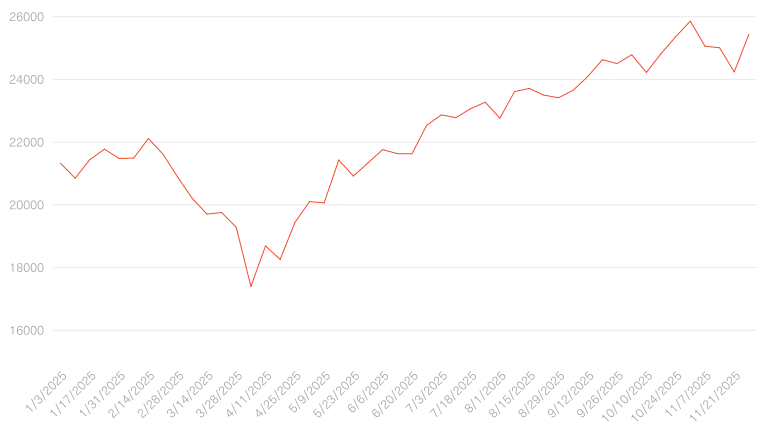
The tech-heavy NASDAQ index is up over 19% since the start of the year.
Opportunity cost: The silent profit killer
The biggest risk to a gold-only strategy in 2026 isn't necessarily a price crash. It is stagnation.
Gold can go through long periods of consolidation. It might range between key support and resistance levels for months, offering limited opportunities for significant gains unless you are scalping tiny movements. While your capital is tied up waiting for gold to break out, other markets could be trending strongly.
Consider the opportunity cost. Every pound of margin used to hold a stagnant gold position is a pound that cannot be used to trade a breakout in the NASDAQ 100 or a trend reversal in GBP/USD.
The equity boom you might miss
Let's look at the numbers. In 2023, while gold had a respectable year, the S&P 500 rallied over 24% [Source: S&P Global]. Traders who were exclusively focused on metals missed one of the easiest trend-following opportunities of the decade.
Diversifying allows you to be where the action is. If gold is quiet, you can look to indices. If indices are choppy, you might find a clean trend in energy commodities.
HEDGE GOLD WITH FXTM - LOW SPREAD PINPOINT EXECUTION ETC
Shiller CAPE Ratio 2023-2025
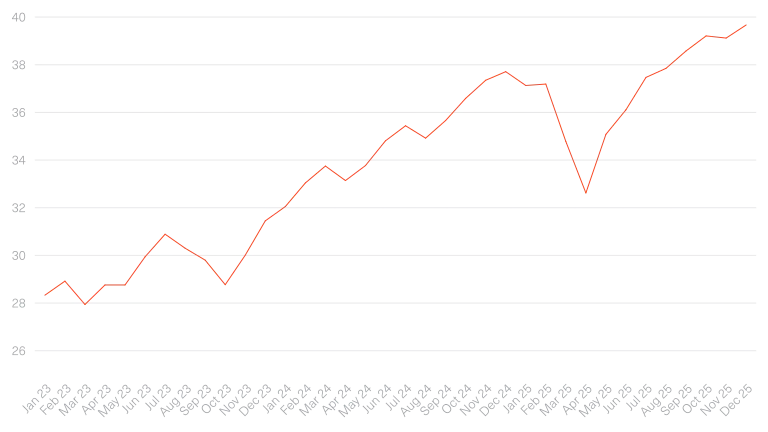
The Shiller CAPE ratio has remained above the historically significant 30 benchmark since the start of 2024.
How to hedge gold: Practical strategies
So, you accept the need to diversify. But how do you actually hedge gold without complicating things too much? The goal is not to trade 50 different instruments, but to add 2 or 3 that complement your main focus.
Understanding what actually moves gold
To effectively hedge gold, you need to understand what moves it. It is rarely as simple as "inflation up, gold up."
Intermediate traders know that three main factors drive XAU/USD:
- The US Dollar (USD): Since gold is priced in dollars, a stronger dollar usually makes gold cheaper (and vice versa).
- Real Yields: This is the return on government bonds minus inflation. Gold pays no interest. When bond yields are high and beating inflation, holding gold becomes less attractive.
- Central Bank Buying: The demand from major institutions creates a floor for prices.
The real yield trap
In 2026, interest rate policies are diverging globally. If the Federal Reserve maintains higher rates to combat stubborn inflation, real yields could remain positive. This creates a headwind for gold.
If you only trade gold, you are implicitly betting against the US economy and the US dollar. Is that a bet you want to make with 100% of your capital?
Here are a few go-to hedges you can look at instead.
1. The USD hedge (USD/JPY or EUR/USD)
Since gold often moves inversely to the dollar, trading a major currency pair can act as a natural hedge.
- Scenario: You are long gold, expecting it to rise.
- The Risk: Unexpected strong US economic data boosts the dollar, sending gold down.
- The Hedge: You could open a small long position on USD/JPY. If the dollar spikes, your USD/JPY trade profits, offsetting some of the losses on your gold position.
This works because you are essentially backing the dollar on one trade while betting against it on the other, but with different nuances (Gold reacts to fear/yields; USD/JPY reacts to yield differentials).
2. The "risk-on" hedge (Indices)
Gold is a "risk-off" asset. Indices like the S&P 500 or NASDAQ are "risk-on."
[link to indices page and give FXTM trade name]
If market sentiment is optimistic, money flows out of safe havens and into stocks. By trading an index alongside gold, you can capture moves regardless of the market mood.
- Strategy: If the market enters a "risk-on" phase (good economic news, geopolitical calm), look for long setups on indices rather than forcing short setups on gold.
3. The commodity correlation (Silver or Oil)
Sometimes, you want to stay within commodities but reduce specific exposure to gold's unique drivers.
Silver (XAG/USD) often moves with gold but with higher volatility ("beta"). Oil (WTI or Brent) is driven by growth and supply dynamics, often decoupling from gold entirely. Adding Oil to your watchlist gives you exposure to the energy sector, which often zigs when precious metals zag.
The psychological benefit of diversification
There is a mental aspect to trading that is often overlooked. When you trade only one asset, you become emotionally attached to its performance. A bad week for gold becomes a bad week for you.
This tunnel vision leads to:
- Overtrading: forcing trades in a choppy market because you "need" to be active.
- Revenge trading: increasing position size to win back losses from the same asset that caused them.
- Bias: ignoring bearish signals because you are permanently bullish on gold.
Diversification breaks this cycle. If gold is acting irrationally or consolidating, you can simply step away and look at the DAX or the Euro. It keeps your mind fresh and your analysis objective.
Building a balanced watchlist for 2026
You don't need to become a master of every asset class. To start diversifying, try adding just three non-metal instruments to your daily analysis.
Here is a sample "Diversified Watchlist" for an intermediate trader:
- Primary: XAU/USD (Gold)
- Forex: EUR/USD (High liquidity, inverse correlation to DXY)
- Index: US500 (Broad market sentiment gauge)
- Energy: WTI Crude (Global growth indicator)
By scanning these four charts every morning, you get a holistic view of the market. You can see where the money is flowing. Is it flowing into safety (Gold)? Into growth (US500)? Or is it purely a currency play (EUR/USD)?
The role of tech in multi-asset trading
In the past, trading multiple asset classes meant having multiple accounts with different brokers. You needed a stockbroker, a futures broker, and a forex dealer.
Today, platforms like FXTM allow you to trade CFDs on gold, currencies, indices, and commodities from a single account. This makes hedging incredibly efficient. You can see your total exposure in one margin level. You can execute a hedge gold strategy in seconds without logging in and out of different terminals.
Managing margin across assets
A word of caution: diversification requires strict money management. Just because you are trading different assets doesn't mean you should increase your total risk.
If you usually risk 2% of your account on a gold trade, and you decide to open a gold trade and a NASDAQ trade simultaneously, you should split that risk (e.g., 1% on Gold, 1% on NASDAQ). Do not simply double your exposure. The goal is to smooth out your equity curve, not to amplify your volatility.
Actionable next steps for traders
If you’re trading with an account under $50,000, these steps will help you manage risk and build a more resilient approach.
Immediate actions (this week):
- Stop trading gold exclusively. Don’t let all your trades ride on one market.
- Limit your gold exposure to no more than 20% of your weekly trades.
- Add a major pair like EUR/USD to your watchlist. It’s the most liquid and the easiest pair to master.
Short-term moves (this month):
- Structure your approach around a 3-pair portfolio: EUR/USD, USD/JPY, and GBP/JPY.
- Trade primarily during the London/New York overlap (7am–4pm GMT), when spreads are tight and moves are reliable.
- If you must trade outside these hours, use smaller positions to control risk.
- Risk no more than 1% of your account on any single trade—across all pairs combined.
Medium-term steps (next 90 days):
- Track your slippage: compare your expected entry and exit prices with what you actually get.
- Review your real results, not just your trade ideas, to see the true impact of execution costs.
- Make sure your combined win rate stays above 52% to cover slippage and spreads.
- Keep an emotional trading journal. Log every trade and note the situations or thoughts that lead to avoidable mistakes.
Suggested allocation:
- EUR/USD: 50%—build consistency and a stable foundation here.
- USD/JPY: 30%—a safer pair for risk-off periods.
- GBP/JPY: 20%—good for volatility and specialist set-ups.
- Gold: 0–10%—trade gold only if you have a clear, proven edge and never as your main strategy.
By taking these steps, you keep your risk in check, expand your opportunities, and put yourself in a far stronger position than gold-only traders.
The bottom line
The markets of 2026 will not look like the markets of 2020 or 2024. Central bank policies are shifting, geopolitical alliances are changing, and technology is accelerating market movements.
Sticking rigidly to a gold-only approach is like trying to navigate a Dubai with a map from 1990. You might get where you're going eventually, but you'll hit a lot of dead ends along the way.
By choosing to hedge gold and diversify into other liquid markets, you protect your capital from single-asset risks. You open yourself up to more trading opportunities. And ultimately, you become a more rounded, resilient trader.
Don't let your portfolio shine only when gold does. Make 2026 the year you master the broader market.
Ready to broaden your horizons?
Use your knowledge of market movements to your advantage. Sign in to your FXTM account today to hedge gold with currencies, stocks, and indices—all from one place.