


The ultimate guide to position sizing
Learn how to calculate position size, apply the 1% rule, and protect your trading account from day one.
* Trading is risky. Your capital is at risk.
For new traders, placing your first trade is tricky. Many end up losing money when they start without truly understanding why.
Part of the explanation is position sizing. Not strategy. Not market timing. Not choosing the wrong broker.
This guide explains what position sizing is, how to calculate it, and how to build the habit before you risk a single dollar on a live account.
By the end, you will understand the one formula that separates traders who stay in the game long enough to improve from traders who quit inside a month.
Key takeaways
Position sizing is deciding how much to risk before you enter a trade. It's the number of units, lots, or contracts you buy or sell.
Beginner traders should risk no more than 1% of their account on any single trade.
Position sizing is key to managing your trading long-term. A great strategy with poor position sizing can blow up quickly.
Leverage sets how much margin you hold. Position size sets how much you can lose.
What position sizing actually is (and why most beginners skip it)
Most beginners approach trading from the same direction. They find a setup that looks promising. They calculate the potential profit. Then they place the trade.
The question they never ask is: if this trade goes against me, how much do I lose?
Position sizing is the answer to that question. It means deciding, before you enter a trade, exactly how many units, lots, or contracts to buy or sell.
The number is chosen so that if the market moves against you and your stop loss is triggered, the resulting loss is one you planned for.
A position is too large when a single losing trade does serious damage to your account. A position is too small when no sequence of losses could ever hurt you. The goal is to find the size between those two points: large enough to build the account meaningfully over time, small enough to survive a run of bad trades.
Why it matters before strategy, charts, or indicators
Most new traders learn in this order:
- How to read a chart
- How to spot a setup
- How to place an order
Position sizing arrives as an afterthought, usually after the first bad loss. That sequence is backwards.
A trader with no strategy but correct position sizing will lose slowly. Slowly enough to learn. Slowly enough to adjust. A trader with a sound strategy and no position sizing can lose the whole account in one unlucky week.
The size of your trades determines how long you stay in the game. The length of time you stay in the game determines how much you learn. Learning is what makes traders profitable.
Fix the size first. Everything else can improve while you are still trading.
Why new traders often lose
The European Securities and Markets Authority requires brokers across Europe to disclose publicly the percentage of retail accounts that lose money on CFDs. The range sits between 74% and 89%, depending on the broker. Broker profitability disclosures in the US show similar figures for retail forex traders: approximately 70 to 80 percent lose money over time.
A study analysing 8 million trader profiles across 295 million trades found a consistent 74% to 89% loss rate across 27 years, through every major market cycle from the dot-com boom to the COVID crash. Separate research on over 25,000 retail traders found that roughly 65% of them won more trades than they lost.
Here's the striking part.
They were still losing money overall, because their average losing trade cost 2.8% while their average winning trade returned 1.2%. Trading the wrong size made an already unfavourable ratio fatal.
40% of new day traders quit within a month. Only 15% are still trading after three years. The attrition is not random. Most of it happens in the early weeks, when position sizes are largest relative to account equity and the learning curve is steepest.
The over-leverage trap
Here is the sequence that plays out most often.
A new trader opens an account with $500. Their broker offers leverage of 1:100. That means they can control a position worth $50,000. The maths feels exciting. A small move in the right direction generates a proportionally large gain.
What the same maths means in the other direction is equally stark. A 1% adverse move on a $50,000 position is a $500 loss. On a $500 account, that is everything.
At 20:1 leverage, a 5% adverse price movement erases the entire account. At 30:1, the same thing happens in 3.3%. These are not extraordinary moves. On a volatile day, a major currency pair can move that much in an hour.
The leverage was available. That does not mean it was appropriate. The availability of leverage is a facility, not a recommendation.

The 1% rule: the simplest way to stay in the game
The 1% rule is the standard starting point in risk management. It starts "never risk more than 1% of your account balance on a single trade."
- On a $500 account, that is $5 per trade
- On a $1,000 account, $10
- On a $5,000 account, $50
This is not the amount you invest in the trade. It is the maximum you are willing to lose if the trade hits your stop loss and closes automatically. Your position size adjusts until that maximum loss number is at or below 1%.
Most professional traders work within 1 to 2% per trade. For beginners, 1% is the right starting point. After proving a consistent edge across 200 or more trades, there is a case for moving toward 2%. Before that track record exists, there is not.
Why it feels small (and why that is the point)
Five dollars on a $500 account feels insignificant. That feeling is the mechanism.
Position sizing works because it removes the emotional weight from individual trades. When each trade risks 1%, a loss is a data point. Losing five in a row is a bad week, not a catastrophe. The stability that creates is what lets traders improve over time, because they are still trading.
The alternative plays out differently. Risk 10% per trade and a run of five losses, which is unremarkable in almost every trading strategy, takes the account from $1,000 to $590. Recovery requires a 70% gain. Most traders do not get there. They either quit or increase the size further trying to catch up, which makes things worse.
The maths of survival
Lose ten trades in a row risking 1% each time. Your $1,000 account sits at $904. You have lost under 10%, and nothing about your approach needs to change for you to continue trading.
Lose ten trades in a row risking 5% each time. Your account is at $599. You are down 40%, and you need a 67% gain just to get back to where you started.
The trades were identical. The position size changed everything.
How to calculate your position size (step by step)
Next, we'll cover how you can quickly calculate your position size.
The calculation takes about 30 seconds and only needs three inputs:
- your account balance
- your risk percentage
- your stop loss distance
Step 1: decide what you are willing to lose on this trade
Start with your current account balance. Multiply it by your chosen risk percentage.
Account balance x risk percentage = maximum loss per trade.
On a $2,000 account risking 1%, the maximum loss is $20. That number drives everything else.
Step 2: set your stop loss before you enter
A stop loss is the price level at which your trade closes automatically if the market moves against you. It defines the distance between your entry point and where you accept the trade is wrong.
This step matters because position size depends directly on it. A 10-pip stop loss and a 100-pip stop loss require completely different position sizes to produce the same dollar loss.
Set the stop loss based on the chart. Where is the logical level that would invalidate the trade? That determines the stop distance. Never move the stop to accommodate a position size that is already too large.
Step 3: run the calculation
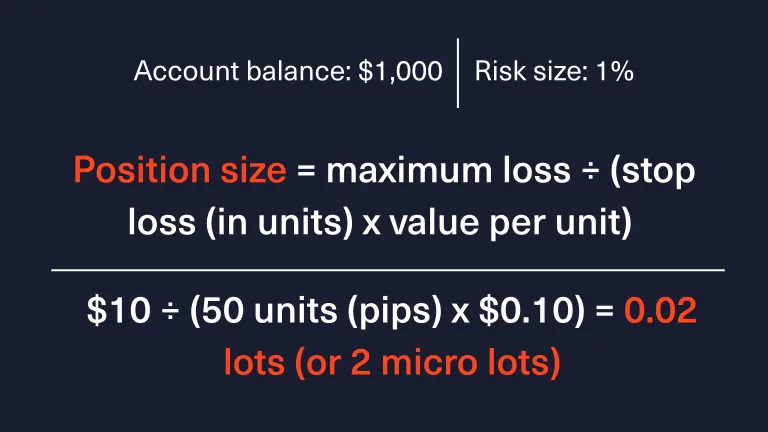
Position size = maximum loss / (stop loss distance x value per unit)
The value per unit depends on the instrument and your account currency. In forex, the standard unit is a lot. The table below shows the three common lot sizes and their approximate pip values on EUR/USD.
| Lot type | Size (units) | EUR/USD pip value (approx.) |
|---|---|---|
Standard lot | 100,000 units | $10.00 per pip |
Mini lot | 10,000 units | $1.00 per pip |
Micro lot | 1,000 units | $0.10 per pip |
A worked example from a $1,000 account
Account balance: $1,000
Risk: 1% = $10 maximum loss
Stop loss: 50 pips
Instrument: EUR/USD using micro lots ($0.10 per pip)
Calculation: $10 / (50 pips x $0.10) = $10 / $5 = 2 micro lots
The correct position size is 2 micro lots (0.02 lots). If the stop loss is triggered, the loss is exactly $10. That is 1% of the account, which was the goal.
Run this calculation before every trade. Not when you remember. Every trade.
How leverage changes the equation
Leverage is the ratio of your position size to the margin required to hold it. At 100:1, $100 of margin controls a $10,000 position.
But leverage does not set the risk. The position size and stop loss do.
A $10,000 position on EUR/USD with a 10-pip stop loss risks approximately $10. That figure does not change whether the account uses 10:1 or 100:1 leverage. The leverage determines how much margin is held aside. The position sizing framework determines how much money is at stake.
The confusion between leverage and risk is one of the most common reasons new traders get into trouble.
The beginner trap: available leverage is not recommended leverage
Brokers like FXTM offer leverage as a facility. The ratio advertised is the maximum available, not the suggested starting point.
The correct order of operations is this. Calculate your position size using the 1% rule. Then check what leverage ratio that requires. In most cases, the position size that follows from correct risk management requires far less leverage than what is on offer.
If the calculation leads you toward the maximum available leverage, the position is too large.
Three position sizing approaches worth knowing
Fixed percentage (start here)
Risk a fixed percentage of the current account balance on every trade. The standard recommendation for beginners is 1%, with professional traders typically working between 1% and 2%.
The advantage is simplicity and automatic adjustment. As the account grows through winning trades, the dollar risk per trade grows with it. As it shrinks through losing trades, the dollar risk per trade shrinks too. The account adjusts to its own health without any manual intervention.
Every trade is treated the same. No judgment calls about which setup deserves a larger bet. No emotional weighting toward trades that feel more certain.
Fixed dollar amount
Risk the same dollar amount on every trade regardless of account balance. Decide the number once, say $25 per trade, and apply it consistently.
This works well for traders who prefer predictable, fixed risk amounts. The limitation is that it does not adjust automatically. After a run of losses, the dollar risk stays the same as a percentage of a now-smaller account, which means the proportional risk has increased.
For beginners, fixed percentage is more robust. Fixed dollar amount is a reasonable option once position sizing is already a consistent habit.
The Kelly Criterion (this comes later)
In 1956, a scientist at Bell Labs named John Kelly published a formula for calculating the optimal bet size based on the probability of winning and the size of the payoff.
Kelly % = W - (1 - W) / R
Where W is the win rate and R is the ratio of average win to average loss.
The formula is theoretically sound. The practical problem is that it requires a reliable track record to produce meaningful inputs. Without hundreds of trades in consistent market conditions, the win rate and win/loss ratio are not stable enough for the formula to give trustworthy results.
Applied to an untested edge, the Kelly Criterion can suggest position sizes that are dangerously large. Most professional traders who use it apply a half-Kelly or quarter-Kelly adjustment as a safety margin.
The fixed percentage method is the right tool for anyone building their first 200 trades. The place to build those trades is a demo account, where the sizing practice is real and the money is not.
A simple pre-trade checklist
Answer these five questions before placing any trade. If any answer is missing, do not place the trade.
1. What is my current account balance?
2. What is 1% of that balance, in my account currency?
3. Where is my stop loss, and how far is that from my entry in pips or points?
4. What is the pip or point value for this instrument at my chosen lot size?
5. What lot size gives me a maximum loss equal to or below my 1%?
The arithmetic takes 30 seconds. The habit of running it takes longer to build. Building it on a demo account, before real money is at risk, is the most practical way to make it automatic.
The bottom line
The market does not know how much is in your account. It does not adjust its behaviour based on what you can afford to lose.
As a new trader, that is your job to work out!
Position sizing is how you do it. Learn the formula on a demo account, where the practice is real and the stakes are not. Run the calculation before every trade until it becomes automatic. By the time you are trading real money, the habit should already be settled.
Ready to explore the world of trading? Try a demo account and trade risk-free with FXTM today.
Frequently asked questions
Position sizing is the process of deciding how many units, lots, or contracts to buy or sell on a given trade, so that if the trade hits your stop loss, you lose a specific, pre-decided amount.
That amount is typically capped at 1% of the account balance. It is the mechanism that controls how much risk you take on each trade.
Use the formula: Position size = (Account balance x risk %) / (stop loss in pips x pip value per lot).
For a $1,000 account risking 1%, with a 50-pip stop on EUR/USD and a micro lot pip value of $0.10, the calculation produces 2 micro lots.
Many brokers also provide free position size calculators.
For beginners, 1% is the right starting point. At 1% risk per trade, ten consecutive losses leave more than 90% of the account intact.
Professional traders typically work within 1 to 2% per trade, and only after establishing a track record of consistent results.
Leverage determines how much margin you need to hold a position, not how much you can lose on it.
The risk on a trade is set by the position size and stop loss distance. Calculate your position size from the 1% rule first. The leverage required to hold that position will, in most cases, be well below the maximum available.
Leverage determines how much margin you need to hold a position, not how much you can lose on it. The risk on a trade is set by the position size and stop loss distance.
Calculate your position size from the 1% rule first. The leverage required to hold that position will, in most cases, be well below the maximum available.